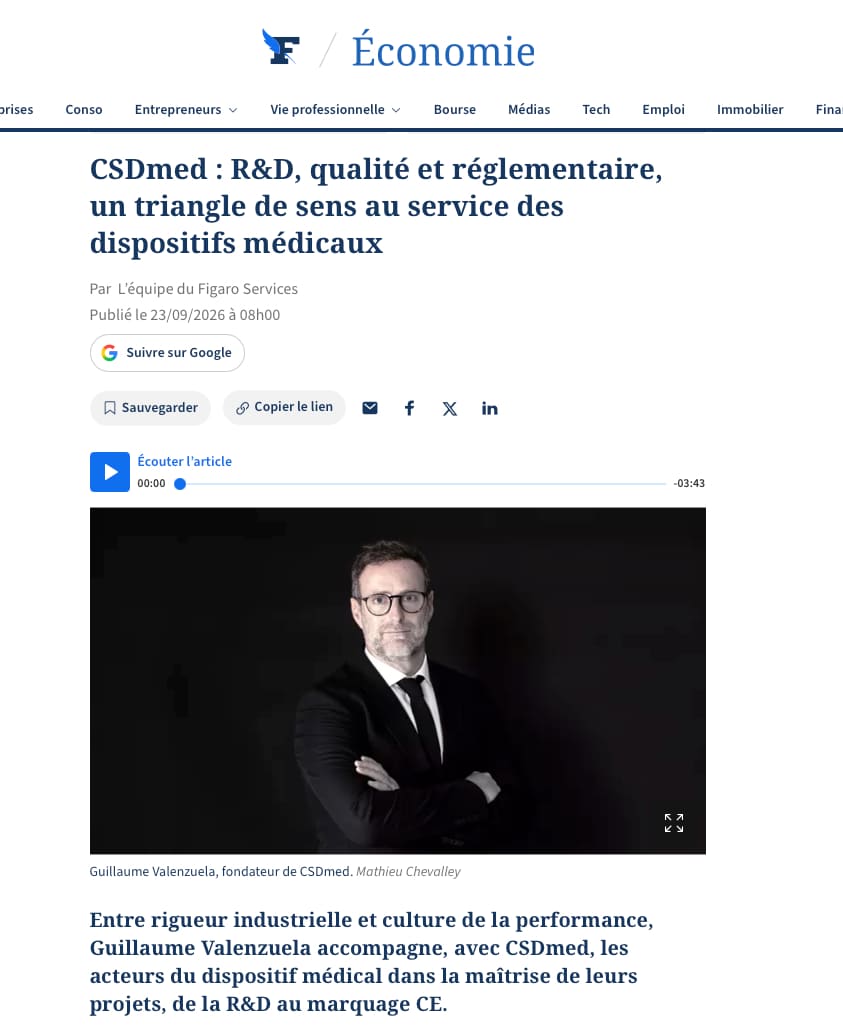
CSDmed in *Le Figaro*: R&D, Quality, and Regulatory Affairs in the Medical Device Industry
Press Review
On September 23, 2026, Le Figaro published a profile of CSDmed and its founder, Guillaume Valenzuela, focusing on a core belief that shapes the way we work: when it comes to medical devices, R&D, quality, and regulatory affairs should never be viewed as three separate areas.
The article, titled “CSDmed: R&D, Quality, and Regulatory Affairs—A Meaningful Triangle Serving Medical Devices, ” traces the journey that led to the founding of CSDmed, but above all, it highlights how we support manufacturers, from design through CE marking.
Read the CSDmed article in Le Figaro
Explore the “In the News” section
Beyond the profile, this publication is an opportunity to revisit a principle that seems simple but becomes much less obvious once a project gets underway: a medical device isn’t developed on one side while quality and regulatory teams handle compliance on the other.
Why can’t R&D, quality, and regulatory affairs be managed separately in a medical device project?
In many projects, these three areas are still addressed sequentially.
R&D develops the product. Quality establishes the QMS and procedures. The regulatory team steps in when it’s time to prepare the technical dossier and obtain CE marking.
On paper, each has its own scope. In reality, the boundaries are much less clear-cut.
A design decision can alter the device’s risk profile. A regulatory requirement may mandate certain verification or validation activities. A change in the intended use can affect the classification, clinical evaluation, or regulatory strategy. The results of risk management can themselves lead to design changes.
And, in the end, the technical documentation must demonstrate the consistency of the entire project.
It is precisely this overall consistency of the project that is highlighted in the profile published by Le Figaro.
TheISO 13485-compliant quality management system, risk management according toISO 14971, design activities, verification and validation, clinical evaluation, and regulatory documentation are not layers that are gradually added to the product.
They are all part of the same system.
At what point should regulatory requirements be integrated into the development of a medical device?
As early as possible.
This doesn’t mean turning every design meeting into a three-hour regulatory review. That would be a pretty effective way to make everyone hate the MDR.
Rather, it’s about identifying early enough the requirements that may influence product development.
Under Regulation (EU) 2017/745 (MDR), the manufacturer must be able to demonstrate control over its device throughout its lifecycle. This involves, in particular, linking the applicable requirements, risk management, design choices, verification and validation activities, and clinical data.
For a device also intended for the U.S. market, the strategy must also take into account FDA requirements and applicable design control activities early enough in the process.
In the profile published by Le Figaro, this approach is summarized by an idea that is particularly important to us: regulation should not be viewed solely as a constraint to be met, but as a framework for structuring the project.
When integrated early enough, it helps clarify decisions, better manage risks, and avoid having to reconstruct the demonstration of compliance after the fact.
Because “putting together the regulatory dossier” once the product is finished is technically possible in some cases.
It’s just that it’s rarely the most pleasant way to discover that certain pieces of evidence should have been generated two years earlier.
How can we support a MedTech startup in developing a medical device?
For a startup, the challenge is generally to establish sufficient structure from the outset without building an organization that is disproportionate to the project’s maturity.
Let’s take the example of a young company developing its first medical device.
The team is often very product-focused. It has a thorough understanding of the technology it is developing but must simultaneously familiarize itself with the MDR, ISO 13485, ISO 14971, design documentation, clinical evaluation, and the expectations of a notified body.
The goal is not to slow down R&D by immediately imposing an organizational structure befitting a manufacturer marketing fifty products.
Instead, it is essential to lay the right foundations early on: regulatory strategy, device classification, design requirements, risk management, V&V planning, traceability of decisions, and an appropriate quality system.
It is this initial structuring that then allows the project to move forward without having to constantly backtrack.
Le Figaro specifically highlights CSDmed’s role in supporting startups: simultaneously structuring R&D, the quality system, and the CE marking strategy from the very earliest stages of the project.
And what about an established medical device manufacturer?
The challenge is often different.
Let’s imagine, this time, a manufacturer that already has an ISO 13485 QMS, marketed products, and well-structured R&D, quality, and regulatory affairs teams.
It’s no longer a matter of laying the groundwork.
It is often necessary to identify why elements that work individually do not tell exactly the same story when brought together.
A requirement appears in the specifications but not in the verification plan. A risk control measure is claimed in the risk management dossier without clear evidence of its validation. An indication differs slightly between the Instructions for Use (IFU), the clinical evaluation, and the technical documentation. A design change was indeed implemented, but its regulatory traceability is incomplete.
Taken separately, each of these discrepancies may seem minor.
When a notified body starts pulling on the thread, the situation quickly becomes more interesting.
In this context, support is more about securing the technical documentation, aligning practices, and restoring consistency among the various components of the dossier. This is the other situation described in the Figaro article.
These two examples illustrate why support for a MedTech company cannot be fully standardized: the needs of a company developing its first prototype are not the same as those of a manufacturer preparing a new MDR submission or addressing non-conformities identified by a notified body.
Why does CSDmed combine technical and regulatory expertise?
CSDmed is a Monaco-based consulting firm specializing in medical device development, with an approach that encompasses R&D, quality, and regulatory affairs.
This approach stems largely from its history.
Before founding CSDmed in 2020, Guillaume Valenzuela worked in several industrial sectors—including aerospace, automotive, electronics, and complex technical systems—before spending nearly twelve years at a Monegasque medical device manufacturer.
This dual background—in engineering and medical devices—partly explains our approach to regulatory matters.
A requirement only truly makes sense if one understands what it implies for the product and the project.
Conversely, an excellent technical decision can become problematic if its implications for risk, verification, validation, or regulatory compliance have not been anticipated.
This is also why CSDmed participates in AFNOR working groups: understanding the texts is essential, but understanding their logic, their evolution, and their practical implications for manufacturers is just as important.
How can we make medical device regulations more pragmatic?
Being pragmatic does not mean reducing regulatory requirements.
It means doing what is necessary, at the right time, with a level of justification appropriate to the risk and the project.
A good quality system is not one that has the greatest number of procedures.
A good technical dossier is not the one with the most pages.
And a good regulatory strategy is certainly not the one that produces the most Excel spreadsheets.
What matters is being able to demonstrate, in a consistent and well-documented manner, why the device is safe, effective, and compliant with the applicable requirements.
This philosophy echoes a quote from the article in *Le Figaro*:
“Performance is built on attention to detail, consistency, and the ability to maintain high standards right up to the very end.”
It originally comes from the world of sports. But it quite accurately describes what also distinguishes a well-managed medical device project from one in which compliance must be retroactively addressed at the end.
FAQ – Medical Device Consulting and Regulation
What is a medical device regulatory consultant?
A medical device regulatory consultant assists a manufacturer in identifying, interpreting, and implementing the requirements applicable to its product and organization. Depending on the project, their involvement may cover regulatory strategy, CE marking under the MDR 2017/745, technical documentation, risk management, the ISO 13485 quality management system, or FDA requirements.
When should an MDR consultant be brought in for a medical device project?
Ideally, from the earliest stages of development, when certain decisions may impact classification, clinical strategy, risk management, or verification and validation activities. It is still possible to bring a consultant on board at a later stage, particularly to ensure the compliance of existing technical documentation or to address nonconformities identified during an assessment.
Does CSDmed only provide support for CE marking under the MDR?
No. CSDmed’s support covers three areas: R&D, quality, and regulatory affairs, including product development, ISO 13485 quality management systems, the MDR 2017/745, risk management, and FDA regulatory issues.
Can CSDmed assist manufacturers outside of Monaco and France?
Yes. CSDmed is based in Monaco and works with medical device manufacturers in France as well as internationally. This international aspect of the business is also highlighted in the profile published by Le Figaro.
Conclusion
Structuring R&D, quality, and regulatory affairs early on obviously does not eliminate the complexity of developing a medical device.
However, it does allow us to manage that complexity.
As we explain in the Le Figaro article, when the foundations are solid, projects can move forward more smoothly, more quickly, and, above all, more robustly.
This is precisely the role CSDmed seeks to play for manufacturers: providing sufficient expertise and structure to ensure the project’s success, while maintaining a pragmatic approach tailored to the product, the company, and its level of maturity.
We’re available to discuss your projects and help you structure a development process that is solid, efficient, and compliant with CE and FDA requirements. Contact us.
Related Resources
Further reading:
CSDmed in Le Figaro – profile published on September 23, 2026
What They’re Saying About Us – Publications and Media Coverage of CSDmed
ISO 14971 and startups: how to get started with risk analysis without getting lost