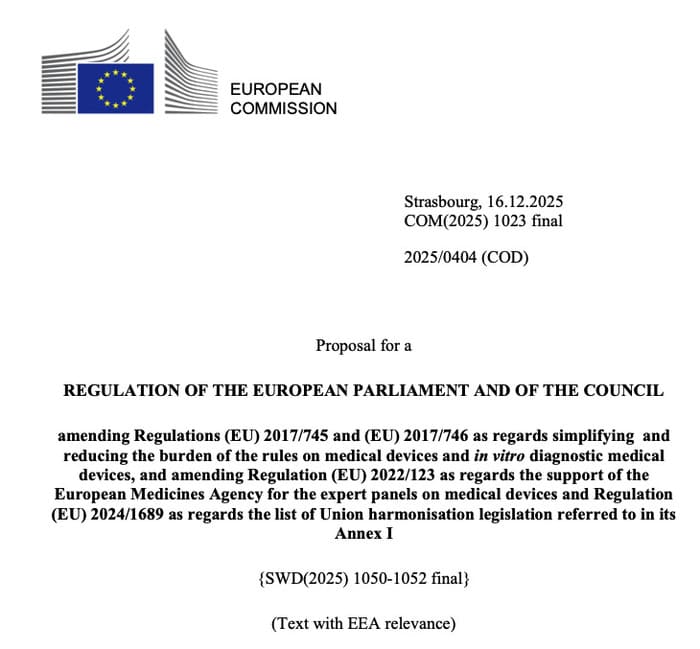
The European Commission wants to simplify MDR and IVDR: what do manufacturers really need to understand?
News
For several years now, MDR and IVDR have been recurrent topics of conversation between manufacturers, notified bodies, consultants... and sometimes therapists caught between product shortages and withdrawals.
At the outset, the ambition was clear and widely shared: to reinforce safety, traceability and confidence in European medical devices. On the ground, the reality has become more mixed. Unpredictable deadlines, varying requirements from one notified body to another, compliance costs with no clear link to the actual risk of the device.
On December 17, 2025, the European Commission finally acknowledged what many manufacturers have been experiencing for a long time: the MDR / IVDR framework, as applied today, is producing counter-productive effects.
Proposal COM(2025) 1023 marks a change of tone. Not a step backwards, but a bold attempt to restore coherence to a system that has become difficult to manage.
Why does the European Union now recognize the limits of the MDR and IVDR?
The novelty of this text lies not so much in its content as in its official diagnosis.
The Commission recognizes that :
- compliance costs are often disproportionate,
- certification deadlines lack predictability,
- interpretations vary between authorities and notified bodies,
- some requirements go far beyond the actual risk of the devices concerned.
This observation does not come from an isolated industry lobby. It is the result of a targeted assessment carried out by the Commission itself, fed by hundreds of field feedbacks, mostly from SMEs.
The message is clear:
mDR and IVDR have improved safety, but at the cost of a complexity that now threatens innovation, device availability and European competitiveness.
What the Commission wants to change... and what it doesn't want to touch
It is important to avoid any naive interpretation.
The proposal does not aim to :
- lighten safety requirements,
- abolish notified bodies,
- return to a more flexible system of directives,
- create systematic fast tracks.
On the contrary, it clearly seeks to:
- reduce redundant requirements,
- improve harmonization of practices,
- reintroduce true risk-based proportionality,
- make certification processes more readable and predictable.
In other words
the level of requirements remains high, but it must once again become comprehensible, anticipatable and justifiable.
Medtech start-ups: a plannable regulatory framework at last?
For a start-up, the MDR is not just a regulatory constraint. It is often a structuring factor of the business model, sometimes discovered too late.
In the field, the difficulties are recurrent:
- clinical requirements poorly calibrated to the stage of maturity,
- uncertainty about the expected level of proof,
- inability to seriously estimate certification times,
- regulatory arbitrations that change along the way.
The Commission's proposal does not turn the MDR into a playground for start-ups. It does not eliminate the need for an early regulatory strategy.
It does, however, open the door to something fundamental: the possibility of planning ahead.
For a start-up, this can mean :
- greater clarity of clinical expectations,
- fewer changes in doctrine during evaluation,
- more consistent dialogue with notified bodies.
CSDmed reading:
a start-up will still not be able to "improvise" its compliance. But it may finally be able to build a product knowing what to expect, which changes everything. Well, that's what they say, but we'll see what happens in reality..
SMEs: towards more proportionate... or simply clearer compliance?
SMEs are clearly at the heart of the text. And with good reason: they represent the bulk of Europe's medtech industry.
Today, many SMEs are faced with :
- documentation requirements equivalent to those of large groups,
- lengthy and costly audits,
- sometimes inconsistent demands between notified bodies,
- the temptation to withdraw devices that are clinically useful.
The Commission explicitly recognizes that this situation is unsustainable.
If the proposal succeeds, SMEs could benefit from :
- more harmonized assessment practices
- fewer redundant reviews,
- better recognition of existing data,
- requirements better aligned with actual risk and device history.
But beware:
this does not dispense with the need for a solid quality management system. On the contrary, it calls for a better thought-out, more coherent and less bureaucratic QMS.
CSDmed reading:
compliance is not a stack of procedures. It's a system of controlled decisions, capable of being explained and defended.
Large groups and combination products: the challenge of regulatory consistency
For large groups, and in particular pharma players involved in combination products, the problem is not so much the level of requirements as the fragmentation of regulations.
In the field, this means
- complex interfaces between MDR, IVDR and pharmaceutical regulations,
- lengthy discussions on classification,
- multiple interactions with different authorities,
- high regulatory risk for strategically important products.
The COM(2025) 1023 proposal introduces several interesting signals:
- an expanded role for the EMA,
- greater support for national authorities in borderline cases,
- better coordination with the reform of pharmaceutical legislation and the Biotech Act.
For combination products, the stakes are clear:
fewer silos, greater consistency in arbitration, and a better ability to anticipate regulatory decisions.
Governance, experts, EMA: towards less divergence in the field?
The Commission does not call into question the decentralized approach, but recognizes its limitations.
The text reinforces :
- the role of the MDCG,
- coordination between notified bodies,
- the involvement of expert panels,
- eMA support on complex issues (classification, clinical use, derogations).
The objective is simple:
to reduce differences in interpretation, which today cost time, money and energy to all players.
CSDmed reading:
more centralized governance is only a problem if it adds complexity. Used intelligently, it can actually reduce arbitrariness.
What this text really changes for manufacturers
Let's be clear: this text will not "simplify" compliance in the trivial sense of the term.
It changes something else, something more profound:
it reintroduces regulatory rationality.
In the future, the framework will be more likely to promote :
- truly controlled risk management
- proportionate and coherent clinical evaluation,
- a QMS conceived as a steering tool, not an end in itself.
The Commission's message is clear:
the system should no longer reward those who produce the most documents, but those who know how to justify their technical, clinical and regulatory choices.
It's precisely in this area that support takes on its full meaning.
Not to artificially "simplify" a framework that remains demanding, but to help manufacturers make the right choices, at the right time, and structure them in a coherent way: regulatory strategy, clinical trade-offs, risk management, and a quality system designed as a steering tool.
This pragmatic, proportionate approach is the one we implement at CSDmed, working with start-ups, SMEs and international groups faced with MDR, IVDR and combination products.
If you are in this phase of reflection or arbitration, please contact us to discuss your situation.
Mini-FAQ
Will the revision reduce clinical requirements?
No. The main aim is to make them more proportionate to the risk and history of the device.
Will SMEs have specific rules?
Not "lighter" rules, but a more coherent and predictable framework.
Will combination products be easier to certify?
They will remain complex, but with better coordination between authorities.
When will these changes apply?
Not immediately. The text still has to go through the European legislative process.
Should we wait to launch a new project?
No. The current rules apply in full, and a solid strategy remains essential.
Related resources
- Understanding the importance of risk management plans (RMPs) for medical devices
- Publication of clinical investigation reports: MDCG 2024-15 explained
- Extension of the transitional period for the Medical Device Regulation (MDR 2017/745)