MDR harmonized standards published in January 2026: what manufacturers really need to look at
News
Every time a new harmonized standard is published in the Official Journal, manufacturers ask the same question: should they take action, and if so, how?
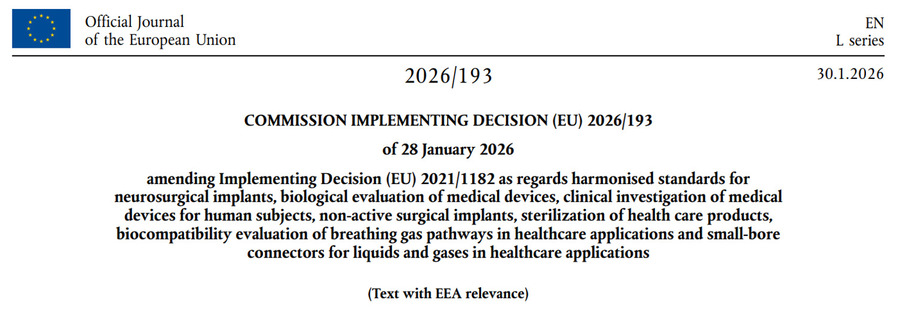
Implementing Decision (EU) 2026/193, published at the end of January 2026, updates the list of harmonized standards applicable to Regulation (EU) 2017/745. The scope covers sensitive areas: implants, respiratory devices, sterilization, clinical investigation.
As is often the case under the MDR, the challenge lies in how the standard fits into an existing technical file, clinical strategy, or quality system already under stress.
Which MDR harmonized standards were published in January 2026?
Decision (EU) 2026/193 amends Decision 2021/1182 by adding new normative references and updating certain existing standards. From the date of their publication in the Official Journal, these standards confer a presumption of conformity to the MDR requirements they cover.
In other words, they become the "natural" reference when dealing with a notified body. Not using them remains possible, but must be justified.
⸻
EN ISO 7197:2024 - Neurosurgical implants
Neurosurgical implants - Sterile, non-reusable hydrocephalus shunt systems
This 2024 version replaces the 2009 edition. It concerns a very precise scope, but with major implications for manufacturers of shunt systems.
In practice, this update may impact:
- certain historical design assumptions
- justification of non-reusability,
- consistency between normative requirements and general MDR safety and performance requirements.
Even for an already MDR-certified device, a gap analysis is rarely avoidable.
⸻
EN ISO 10993-4:2017/A1:2025 - Biological evaluation
Biological evaluation of medical devices - Interactions with blood
This is an amendment, not a complete overhaul. However, its status as an amended harmonized standard is a game-changer.
For devices in contact with blood, this amendment may lead to:
- re-examine the tests carried out,
- complete the scientific justification,
- adjust the arguments presented in biological evaluation and risk management.
Faced with a notified body, the argument "the tests date from before the amendment" is no longer sufficient on its own.
⸻
EN ISO 18562:2024 series - Breathing gas pathways
The series is now harmonized in its 2024 version:
- EN ISO 18562-1:2024 - Risk management
- EN ISO 18562-2:2024 - Particulate emissions
- EN ISO 18562-3:2024 - Volatile organic substances
- EN ISO 18562-4:2024 - Leachables in condensate
These standards relate directly to respiratory, ventilation and anesthesia devices. Their logic is clear: testing is only of value if it is integrated into a coherent risk management approach.
On the manufacturer's side, the questions to be asked are very concrete:
- are existing data still defensible?
- are the initial assumptions still valid for the 2024 version?
- is there a need for additional information, or simply better justification?
⸻
EN ISO 14155:2020/A11:2024 - Clinical investigation
Good clinical practice for medical devices
EN ISO 14155 remains a mainstay of clinical demonstration under MDR. Amendment A11 reinforces certain links with the European regulatory framework.
For manufacturers relying on clinical investigations, this update may have an impact on:
- documentation of ongoing studies,
- consistency between protocol, clinical report and MDR requirements,
- exchanges with the notified body during clinical reviews.
⸻
EN ISO 14630:2024 - Non-active surgical implants
This general standard structures all non-active implants. Its 2024 version replaces the 2012 version and is more closely aligned with MDR logic.
It has a direct influence on:
- design requirements,
- risk management,
- performance demonstration.
Implant-specific standards come next, but rarely in substitution.
⸻
EN ISO 21535:2024 and EN ISO 21536:2024 - Joint prostheses
- EN ISO 21535:2024 - Hip prostheses
- EN ISO 21536:2024 - Knee prostheses
These new versions replace the 2009 editions. They reinforce certain technical and clinical requirements.
For the manufacturers concerned, the question is not only normative, but strategic:
- how far can we capitalize on historical data?
- should clinical strategy be adjusted?
- how can these standards be articulated with EN ISO 14630:2024?
⸻
EN ISO 17665:2024 - Moist heat sterilization
This cross-cutting standard concerns many manufacturers, whether they sterilize in-house or via a service provider.
The 2024 version may impact:
- initial process validation,
- revalidation,
- management of product, load or packaging changes.
Under MDR, sterilization is never simply a "process" issue. It is fully integrated into regulatory compliance.
⸻
EN ISO 80369-2:2024 - Small-bore connectors
Respiratory applications
The ISO 80369 series aims to reduce connection errors, with a direct impact on patient safety. Part 2, dedicated to respiratory applications, is now harmonized in version 2024.
It covers design, compatibility and user information. These are all subjects closely scrutinized by notified bodies.
When does presumption of conformity apply?
The presumption of conformity applies from the date of publication in the Official Journal, i.e. January 2026.
This does not mean that an immediate update is systematically required, but that any use of earlier versions must now be justified, documented and assumed.
Case study 1 - Respiratory device already MDR certified
A manufacturer has an MDR-certified ventilation device. The EN ISO 18562:2024 series has been published.
Two approaches are possible:
- update testing and documentation,
- demonstrate that existing data remain relevant to the new requirements.
In both cases, the notified body expects a structured analysis, not an implicit response.
Case study 2 - Range extension for an orthopedic implant
A manufacturer is preparing a range extension for a hip prosthesis. EN ISO 21535:2024 is now the harmonized reference.
Even if the existing range was based on the 2009 version, the new standard becomes the natural entry point for:
- design,
- validation,
- demonstration of MDR conformity.
⸻
Mini FAQ - MDR harmonized standards
Is a harmonized standard mandatory?
No. But it remains the clearest way of demonstrating conformity.
Does an amendment require immediate updating?
Not necessarily, but a clear justification is expected.
Is it possible to keep an earlier version?
Yes, as long as you can demonstrate that the relevant requirements are still covered.
Do standards replace the MDR?
No. They reflect the expected state of the art, nothing more.
When should I analyze the impact of a new standard?
As soon as it is published, especially in the event of product modification or review by a notified body.
⸻
Related resources
- New guide MDCG 2021-5 rev1 - Guide to medical device standardization
- MDR harmonized standards: April 8, 2025 update, what manufacturers need to remember
- Understanding the importance of the risk management plan (RMP) in medical devices
We are at your service
The publication of new harmonized standards under the MDR rarely raises a simple "yes/no" compliance question. Above all, it requires you to reposition your technical, clinical and documentation choices in line with the recognized state of the art.
Do you need to analyze the impact of new harmonized standards on your devices, technical files or existing practices?
CSDmed supports manufacturers in the critical reading of standards, gap analysis, justification of choices made and the coherent integration of these developments within the framework of MDR 2017/745.
Discussing your situation allows us to identify what really needs to evolve, what can be justified, and what simply needs to be brought into line with your documentation.
Contact us to define a pragmatic, proportionate and defensible approach to dealing with notified bodies.