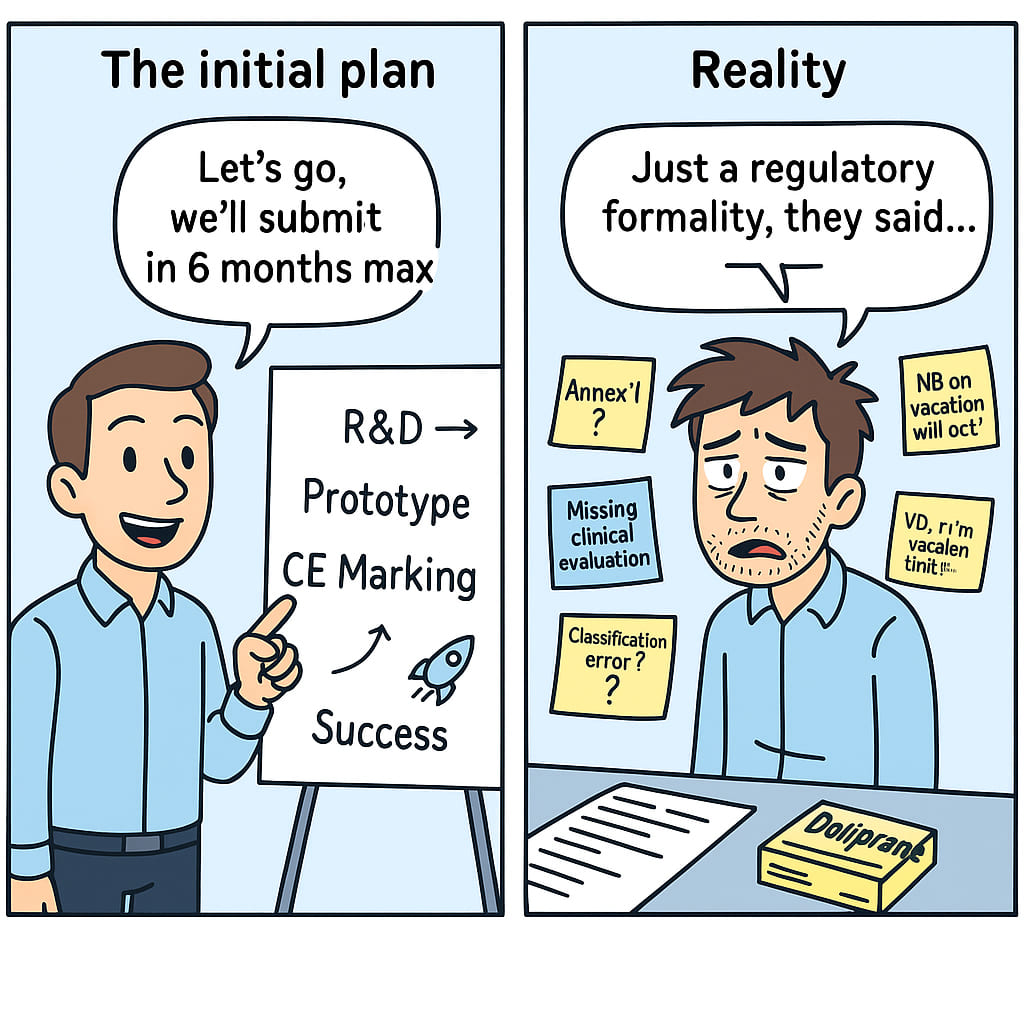
MDR CE marking: pitfalls to avoid as a start-up
News
Creating a medical device is already a technical challenge. Certifying it in accordance with Regulation (EU) 2017/745 is another matter altogether.
And for a start-up, the path is often strewn with pitfalls: lack of regulatory experience, small teams, an over-ambitious product roadmap, or unfamiliarity with the expectations of a notified body.
CE marking isn't just a final stamp: it's the reflection of a system of evidence built up throughout the development process.
In this article, we take a look at the most common pitfalls encountered by start-ups... and, above all, how to avoid them.
1. Not anticipating the impact of MDR on design
Underestimating regulatory requirements right from the R&D phase compromises the whole project.
The MDR requires that a device be designed according to its intended purpose and intended use. These elements, too often vague at the outset, must guide specifications, design and technical choices.
Start-ups that remain in 100% agile mode, without aligning their design with the expectations of CE marking, find themselves trapped.
This is particularly true for interface design, materials, software functions, or cleaning/sterilization requirements.
2. Forgetting Annex I: the checklist to be integrated right from the R&D stage
MDR Annex I is not a form to be ticked off at the end.
It's a set of requirements that structure the design, risk management and justification of clinical performance.
Many start-ups don't get to grips with this issue until it's time to draw up their technical file... and then discover that they have to demonstrate point-by-point compliance with these numerous requirements.
Example: how to meet Annex I in concrete terms
|
Requirement (Annex I) |
What it means for the start-up |
Example of expected proof |
|
§ 10 - Control of biological risks |
Justifying materials in contact with the patient |
Biocompatibility report according to ISO 10993 |
|
§ 14 - Functionality and interoperability performance |
Demonstrate that the device functions as intended in combination with other devices or equipment |
Functional validation plan, test protocols |
|
§ 23 - Information supplied with the device |
Instructions, labeling, language, consistency with intended use |
IFU, labels, language verification |
3. Wrong risk class (and therefore wrong strategy)
A misclassification can derail the whole project.
Start-ups sometimes overestimate the simplicity of their device or underestimate the impact of a software function. As a result, they aim for a Class I... when the regulatory reality is quite different.
The problem?
- The CE marking strategy is based entirely on risk class,
- The wrong choice leads to errors in the technical file,
- And can result in rejection by the notified body, with months of delay.
Case study:
A start-up was developing a remote wound monitoring platform.
Thinking it was in class I (non-invasive software), it discovered along the way that MDR rule 11 required class IIa.
Result: change of strategy, need for a Notified Body, clinical study to consider, 9-month delay.
4. Believing that regulatory documentation comes "afterwards
No, you don't write a technical file "at the end" of a project.
The MDR requires continuous documentation, based on objective data, and consistent with all stages of development.
Points often overlooked:
- Clinical evaluation (to be anticipated well before marketing)
- Risk management strategy
- PMS / PMCF plan
- Justification of Annex I compliance
✅ Useful checklist: have I really started my CE file?
- Destination is defined and documented
- Design specifications are traceable
- A risk analysis has been carried out
- Annex I requirements have been reviewed
- Clinical data collection strategy defined
- User interfaces documented and tested
- Technical file structure defined
- PMS/PMCF requirements are known
- Etc.
5. Underestimating deadlines linked to notified bodies
No, you can't plan a CE audit in 4 weeks.
Between initial contact, contract analysis, admissibility review, file evaluation, questions/answers and the audit... lead times are long and rarely compressible.
And each round of questions adds a further delay. A start-up that doesn't include this in its product roadmap... will find itself out of pocket when it comes time to launch.
Case study:
A start-up planned to submit a dossier in June and go to market in September.
Result:
- Contract signed with NB in July
- Evaluation slot obtained in November
- Certificate issued in April of the following year.
That's 9 months behind the initial business plan.
6. Choosing the wrong regulatory service provider
Choosing an "inexpensive" or "overly generalist" support service can be very costly in the end.
Not all service providers are created equal:
- Some have no experience of MDR,
- Others are FDA specialists,
- And many offer fragmented services, unrelated to product design.
Comparison: which partner for which start-up?
|
Type of service provider |
Advantages |
Limitations |
Ideal for.. |
|
Senior freelancer |
Reactive, expert, cost-effective |
Limited capacity, dependence on 1 person |
Early stage start-up |
|
Specialized CE firm |
Complete team, established method |
Higher cost, sometimes rigid |
Start-up in submission phase |
|
FDA consultant |
Good for structuring a 510(k) approach |
Not suitable for European MDR |
Start-up targeted US only |
|
In-house team |
Product knowledge, proximity |
Need to develop skills |
Scale-up with dedicated team |
7. Mini FAQ: your questions, our answers
Do I need an ISO 13485 QMS to get started?
No, but you do need at least a minimum document structure to frame the design. ISO 13485 becomes essential at the CE submission stage.
Is it possible to change notified body during the course of a project?
It is possible, but cumbersome and costly. It's better to have your strategy validated from the outset with the right NB.
How do I know if my classification is correct?
Read Appendix VIII of the MDR carefully, cross-referencing it with the MDCG guides (particularly Borderline & Classification). If in doubt → seek expert advice.
What should I do if my PMCF is deemed insufficient?
It will be necessary to complete: post-market clinical study, data collection via field feedback, or adjustment of the plan. Anticipating is always more economical than correcting.
Can I do my CE marking without external support?
It's possible, but rare. The risk of regulatory error is high when you're just starting out. Investing in targeted support often pays off.
8. Surround yourself with the right people to avoid making mistakes
CE marking is not a box to be ticked at the end of a project.
It's a strategic, ongoing and demanding process.
For start-ups, the risk is not just regulatory: it's a risk of product mismatch, loss of funding, or even commercial failure.
CSDmed supports start-ups with method, clarity and realism, from initial design to CE certification.
Write to us. We won't do the legwork for you. But we'll help you avoid many pitfalls.
Related resources
- ISO 13485 for start-ups: 3 realistic approaches
- ISO 14971 and start-ups: how to get started on risk analysis without getting lost
- What is good regulatory support for a start-up?